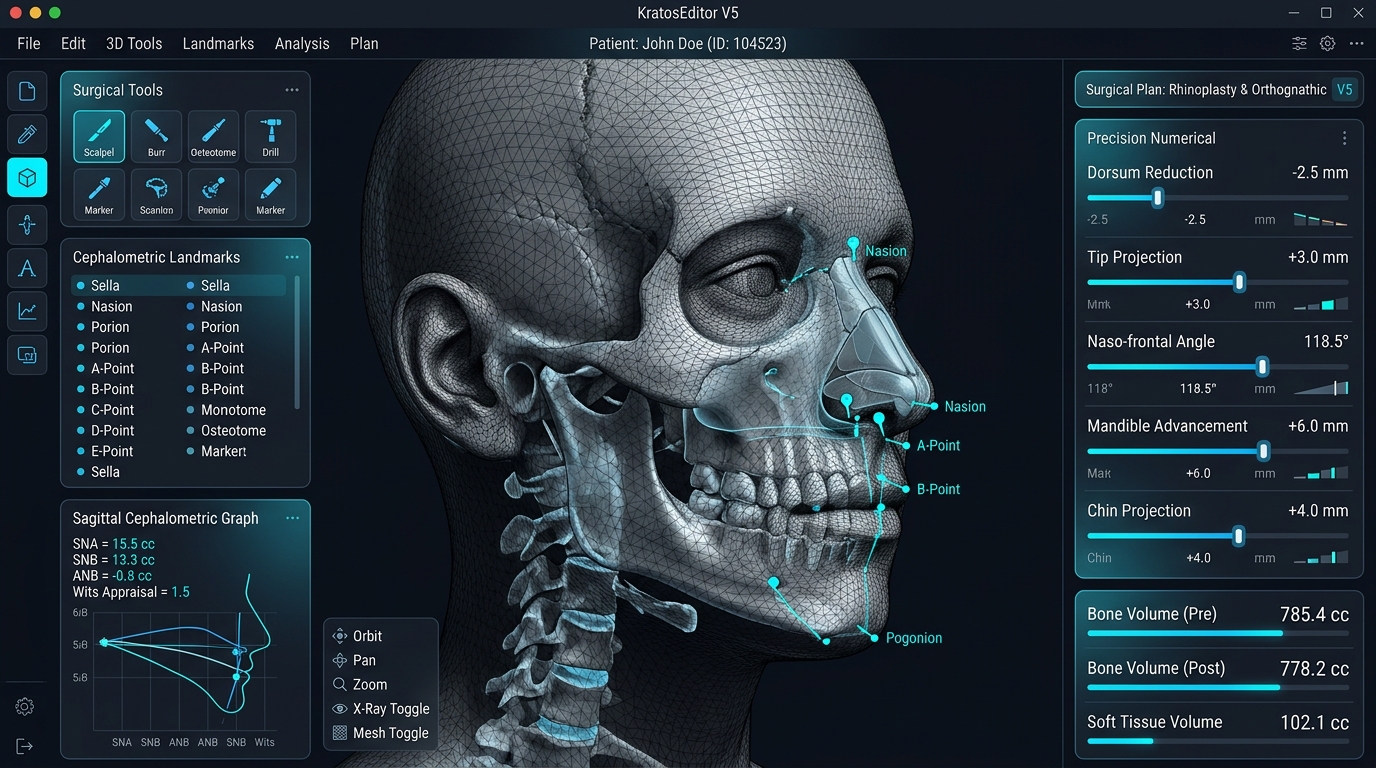
KRATOSEDITOR V5 • OCULOPLASTIC & FACIAL REJUVENATION SUITE

3D Facelift, Blepharoplasty, 3-Zone Brow Lift & Bichectomy Planning

In facial rejuvenation and oculoplastic surgery, static 2D photos fail to capture tissue elevation vectors and dynamic muscle behavior. Kratos 3D unites Upper Blepharoplasty, Lateral Canthopexy, 3-Zone Brow & Temporal Lift, Midface Lift, Bichectomy, and Neck Lift with a live Dynamic Facial Mimic Engine and automated Facial Thirds & Fifths anthropometry.

3-Zone Lift
Medial, Lateral & Temporal/Ponytail Brow Lift
Live Mimics
Test Lifts Under Smile & Brow Contraction
1/3 & 1/5
Horizontal Thirds & Vertical Fifths (mm/%)
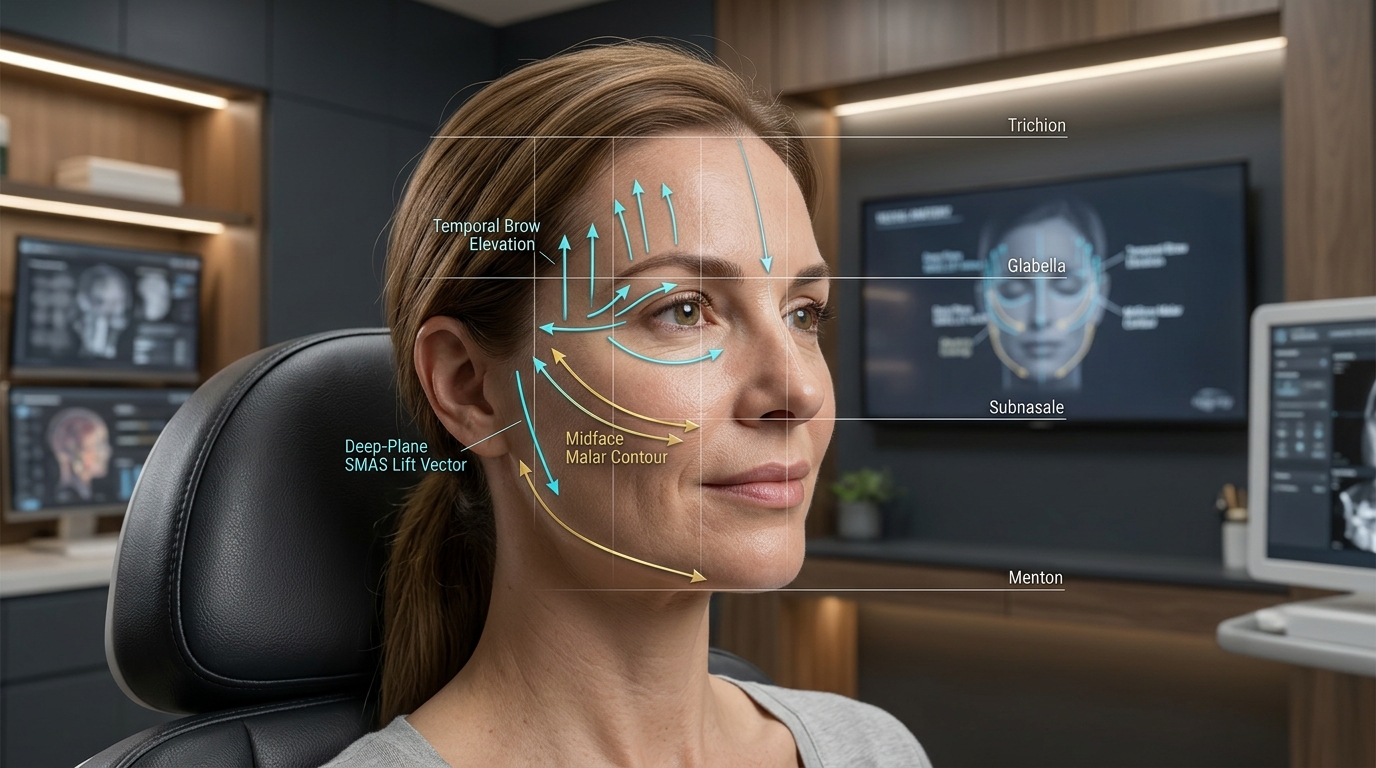
Kratos 3D Facial Surgery Vectors, Blepharoplasty and Facial Proportions
Periorbital, Midface & Cervical Surgery

Region-Specific Surgical Vectors from Upper Eyelid to Cervicomental Angle

Deliver natural, measurable surgical previews with KratosEditor V5's dedicated Orbital, SupraOrbital, Zygomatic, and Labial modules.

Orbital_v1.0 & SupraOrbital_v1.2

Upper Blepharoplasty, Lateral Canthopexy & 3-Zone Brow/Temporal Lift

Simulate upper eyelid skin hooding reduction (Orbital_UpperEyeLid) and positive canthal tilt via Lateral Canthopexy (Orbital_Lateral_Canthopexy). Independently control Left and Right Medial Brow Lift, Lateral Brow Lift, and Temporal / Ponytail Lift vectors, or drag the 3D on-mesh Upper Eye Lid and EyeBrow Lift handles directly.

Upper Blepharoplasty Lateral Canthopexy Medial / Lateral / Temporal Lift Canthal Tilt (°)
Zygomatic_v1.0 • Necklift • Labial_v1.1

Midface Malar Lift, Bichectomy, Platysmaplasty Neck Lift & Bullhorn Lip Lift

Vertical malar fat pad elevation (MidFaceLift), zygomatic arch projection (CheekBoneFill), and independent Left/Right buccal fat pad excision (Bichectomy Effect L/R). Refine the lower third with Neck Lift / Endolift, submental liposuction, and surgical subnasal Bullhorn Lip Lift (LipsShift & Vermilion Roll).

MidFaceLift Bichectomy L/R Necklift / Endolift Bullhorn Lip Shift
Animations_v1.0 & Cadaver Dissection Layer

Dynamic Facial Mimic Testing & Subcutaneous Muscle/Fat Compartments

Prove natural postoperative dynamics: test planned midface lifts, bichectomy, or eyelid surgery under active zygomatic smiling (MouthSmile), mouth opening, and frontalis/corrugator brow movements. Use the X-Ray lens and Cadaver Dissection suite to inspect superficial fat compartments and facial mimic muscles layer by layer.

Dynamic Smile Test Frontalis / Corrugator Superficial Fat Pads Cadaver Dissection Suite
FacialThirds • FacialFifths • Texture Patching

Facial Thirds & Fifths, Periorbital Metrics & Contralateral Texture Patching

Automatically reports Upper (Tr–G), Middle (G–Sn), and Lower (Sn–Me) Horizontal Facial Thirds and Vertical Facial Fifths in millimeters and percentages. Measures Intercanthal/Biocular widths, palpebral fissure dimensions, eyebrow arch angles, and bizygomatic width, plus contralateral skin texture patching across mid and lower facial UV masks.

Horizontal Thirds (33.3%) Vertical Fifths (20%) Palpebral Fissure L/R 1:1 Facial Mask STL
APPLICATION UI PREVIEW SLIDER

KratosEditor V5 — Facial & Oculoplastic Surgery Screens

Slide through the periorbital blepharoplasty, 3-zone brow lift, dynamic mimic, and 1/3 - 1/5 anthropometry screens.

SCREEN 01 / 04 • BLEPHAROPLASTY & BROW LIFT Symbolic UI Preview (Slot #1) KratosEditor V5 Blepharoplasty & Brow Lift UI

Oculoplastic (Blepharoplasty & Canthopexy) and 3-Zone Brow/Temporal Lift

Upper eyelid, canthal tilt, and Medial/Lateral/Temporal brow elevation sliders with 3D control handles.

Orbital_v1.0.json • SupraOrbital_v1.2.json
SCREEN 02 / 04 • MIDFACE, BICHECTOMY & NECK Symbolic UI Preview (Slot #2) KratosEditor V5 Midface Bichectomy Necklift UI

Midface Lift, Bilateral Bichectomy & Neck Lift (Cervicomental Angle)

Zygomatic malar elevation, buccal fat pad reduction, and submental/platysmal neck contouring.

Zygomatic_v1.0.json • Neck_v1.0.json
SCREEN 03 / 04 • 4D DYNAMIC MIMIC ENGINE Symbolic UI Preview (Slot #3) KratosEditor V5 4D Dynamic Mimic Testing

4D Dynamic Stress Testing Under Active Smiling, Blinking & Frowning

Validation of planned surgical vectors under active zygomatic smiling (MouthSmile) and periorbital muscle movement.

EditScreenController.UI.RightPanel.Animation.cs • Animations_v1.0.json
SCREEN 04 / 04 • THIRDS/FIFTHS & ANATOMY Symbolic UI Preview (Slot #4) KratosEditor V5 Anthropometric Thirds Fifths & Cadaver Layers

Horizontal Thirds (1/3), Vertical Fifths (1/5) & Cadaver Anatomy Layers

Automated 1/3 and 1/5 anthropometric facial proportion tables and subcutaneous muscle/fat dissection layers.

EditScreenAnalysisVisualizer.cs • CadaverScreenController.cs
CLINICAL Q&A

Frequently Asked Questions: 3D Facial Surgery, Blepharoplasty & Facelift Planning

Wie simuliert Kratos 3D Blepharoplastik, Brauenlift, Bichektomie sowie Gesichts- und Halsstraffung?

Kratos 3D verfügt über spezialisierte Module für Oberlid-Blepharoplastik, laterale Kanthopexie, 3-Zonen-Augenbrauen- und Schläfenlift (Medial, Lateral, Temporal), Midface-Lift, Bichektomie sowie Halsstraffung und Lip-Lift.

Können Chirurgen geplante Ergebnisse unter dynamischer Gesichtsmimik wie Lächeln testen?

Ja. Mit der dynamischen Mimik-Simulation können Arzt und Patient prüfen, wie sich Midface-Lift, Bichektomie oder Lidkorrekturen beim Lächeln und bei Stirnbewegungen verhalten.

Welche anthropometrischen Gesichtsproportionen und periorbitalen Metriken werden automatisch berechnet?

Automatisch berechnet werden horizontale Gesichtsdrittel, vertikale Gesichtsfünftel, Interkanthal- und Biokularabstand, Canthal-Tilt-Winkel, Jochbeinbreite sowie chimäre Spiegelansichten zur Asymmetrieanalyse.

Können nicht-operative Methoden ein chirurgisches Facelifting ersetzen?

Bei leichter bis mäßiger Erschlaffung sind Filler und Geräte sehr effektiv. Bei starkem Hautüberschuss und SMAS-Ptose kann jedoch nur ein operatives Facelift das gewünschte Ergebnis liefern.

Was ist eine Otoplastik (Ohrenkorrektur) und wann sollte sie durchgeführt werden?

Die Otoplastik korrigiert abstehende Ohren durch Knorpelformung und Angleichung des Winkels. Der Eingriff ist ab dem 5.–6. Lebensjahr sicher durchführbar.

Wie sollte die Entscheidung für den richtigen ästhetischen Eingriff getroffen werden?

Die Planung sollte nicht auf Trends beruhen, sondern auf objektiver 3D-Biometrie, Gewebeelastizität, Knochenstruktur und maßgeschneiderter ärztlicher Beratung.

AI / LLM Machine-Readable Technical Specification: /content/facial_surgery.md