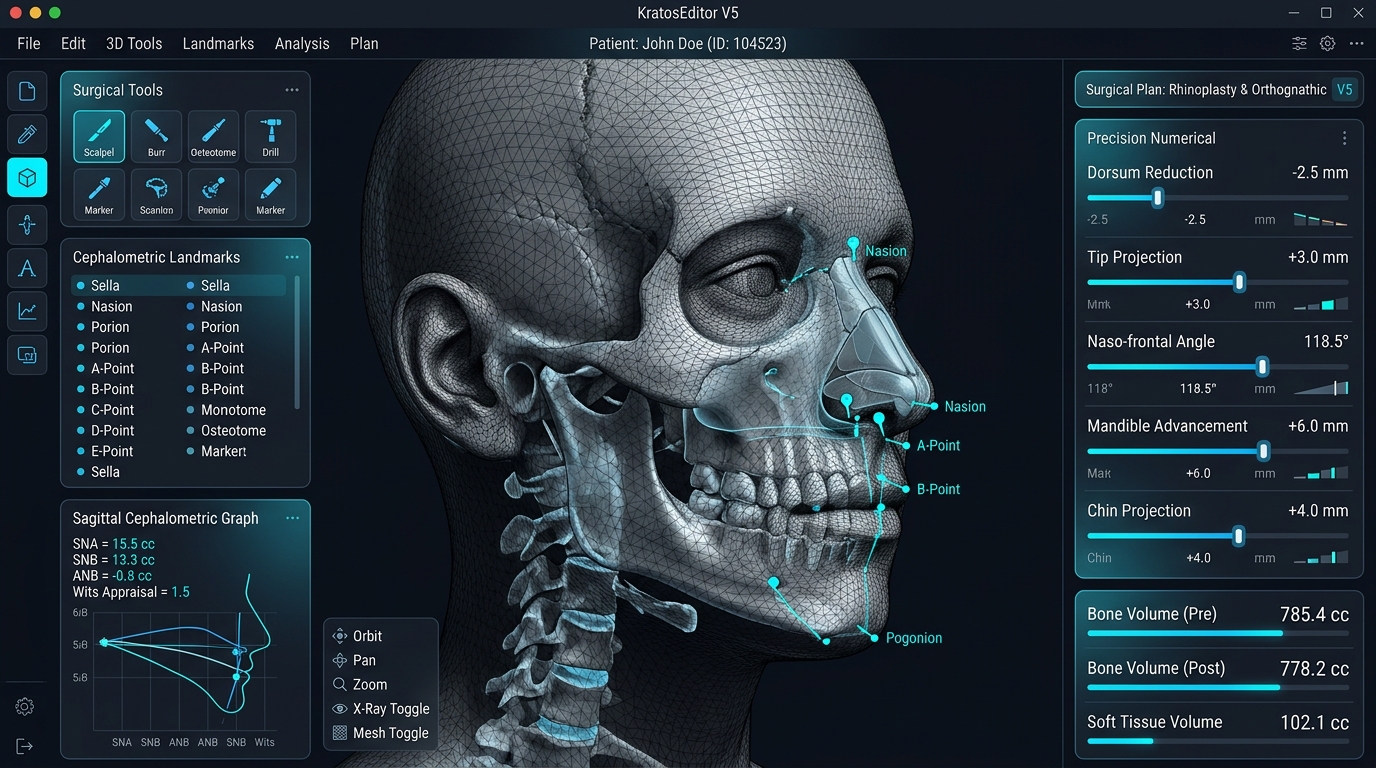
KRATOSEDITOR V5 • OCULOPLASTIC & FACIAL REJUVENATION SUITE

3D Facelift, Blepharoplasty, 3-Zone Brow Lift & Bichectomy Planning

In facial rejuvenation and oculoplastic surgery, static 2D photos fail to capture tissue elevation vectors and dynamic muscle behavior. Kratos 3D unites Upper Blepharoplasty, Lateral Canthopexy, 3-Zone Brow & Temporal Lift, Midface Lift, Bichectomy, and Neck Lift with a live Dynamic Facial Mimic Engine and automated Facial Thirds & Fifths anthropometry.

3-Zone Lift
Medial, Lateral & Temporal/Ponytail Brow Lift
Live Mimics
Test Lifts Under Smile & Brow Contraction
1/3 & 1/5
Horizontal Thirds & Vertical Fifths (mm/%)
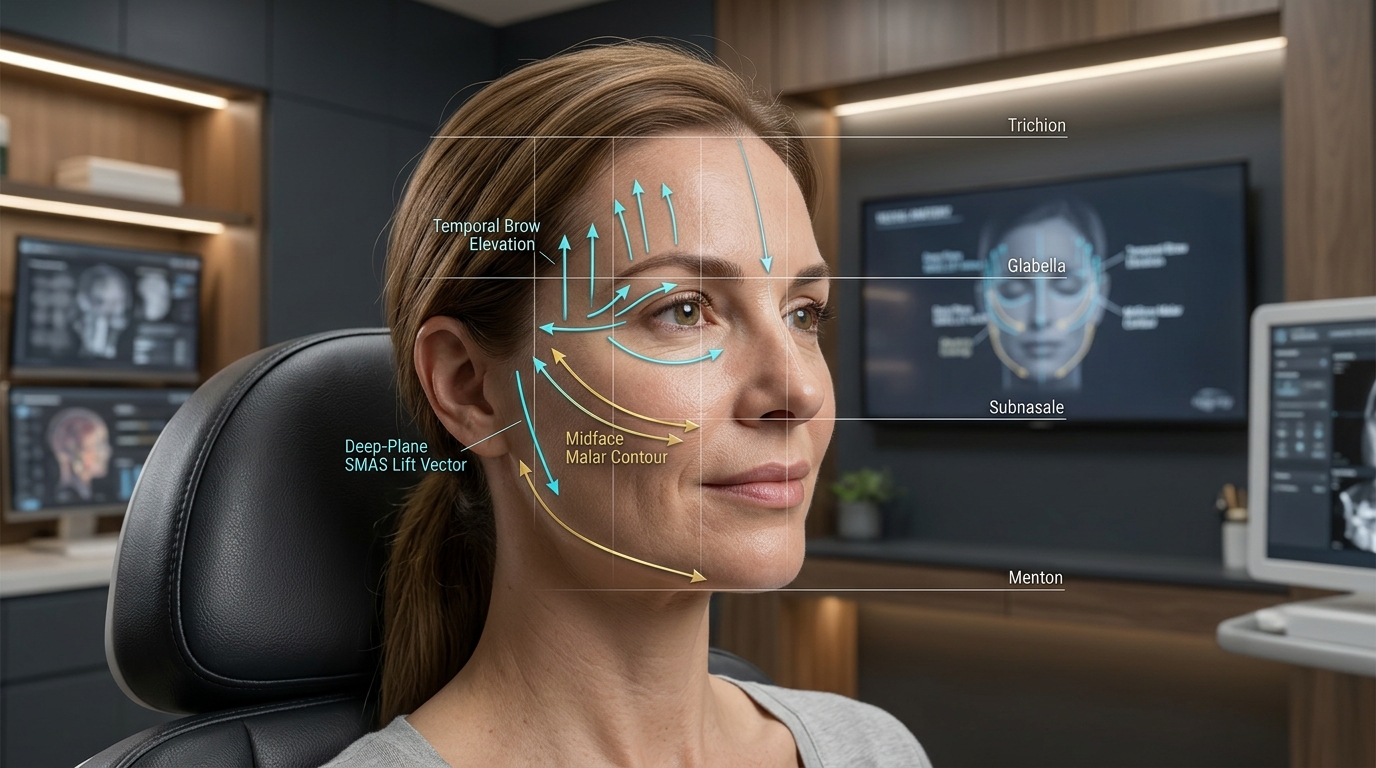
Kratos 3D Facial Surgery Vectors, Blepharoplasty and Facial Proportions
Periorbital, Midface & Cervical Surgery

Region-Specific Surgical Vectors from Upper Eyelid to Cervicomental Angle

Deliver natural, measurable surgical previews with KratosEditor V5's dedicated Orbital, SupraOrbital, Zygomatic, and Labial modules.

Orbital_v1.0 & SupraOrbital_v1.2

Upper Blepharoplasty, Lateral Canthopexy & 3-Zone Brow/Temporal Lift

Simulate upper eyelid skin hooding reduction (Orbital_UpperEyeLid) and positive canthal tilt via Lateral Canthopexy (Orbital_Lateral_Canthopexy). Independently control Left and Right Medial Brow Lift, Lateral Brow Lift, and Temporal / Ponytail Lift vectors, or drag the 3D on-mesh Upper Eye Lid and EyeBrow Lift handles directly.

Upper Blepharoplasty Lateral Canthopexy Medial / Lateral / Temporal Lift Canthal Tilt (°)
Zygomatic_v1.0 • Necklift • Labial_v1.1

Midface Malar Lift, Bichectomy, Platysmaplasty Neck Lift & Bullhorn Lip Lift

Vertical malar fat pad elevation (MidFaceLift), zygomatic arch projection (CheekBoneFill), and independent Left/Right buccal fat pad excision (Bichectomy Effect L/R). Refine the lower third with Neck Lift / Endolift, submental liposuction, and surgical subnasal Bullhorn Lip Lift (LipsShift & Vermilion Roll).

MidFaceLift Bichectomy L/R Necklift / Endolift Bullhorn Lip Shift
Animations_v1.0 & Cadaver Dissection Layer

Dynamic Facial Mimic Testing & Subcutaneous Muscle/Fat Compartments

Prove natural postoperative dynamics: test planned midface lifts, bichectomy, or eyelid surgery under active zygomatic smiling (MouthSmile), mouth opening, and frontalis/corrugator brow movements. Use the X-Ray lens and Cadaver Dissection suite to inspect superficial fat compartments and facial mimic muscles layer by layer.

Dynamic Smile Test Frontalis / Corrugator Superficial Fat Pads Cadaver Dissection Suite
FacialThirds • FacialFifths • Texture Patching

Facial Thirds & Fifths, Periorbital Metrics & Contralateral Texture Patching

Automatically reports Upper (Tr–G), Middle (G–Sn), and Lower (Sn–Me) Horizontal Facial Thirds and Vertical Facial Fifths in millimeters and percentages. Measures Intercanthal/Biocular widths, palpebral fissure dimensions, eyebrow arch angles, and bizygomatic width, plus contralateral skin texture patching across mid and lower facial UV masks.

Horizontal Thirds (33.3%) Vertical Fifths (20%) Palpebral Fissure L/R 1:1 Facial Mask STL
APPLICATION UI PREVIEW SLIDER

KratosEditor V5 — Facial & Oculoplastic Surgery Screens

Slide through the periorbital blepharoplasty, 3-zone brow lift, dynamic mimic, and 1/3 - 1/5 anthropometry screens.

SCREEN 01 / 04 • BLEPHAROPLASTY & BROW LIFT Symbolic UI Preview (Slot #1) KratosEditor V5 Blepharoplasty & Brow Lift UI

Oculoplastic (Blepharoplasty & Canthopexy) and 3-Zone Brow/Temporal Lift

Upper eyelid, canthal tilt, and Medial/Lateral/Temporal brow elevation sliders with 3D control handles.

Orbital_v1.0.json • SupraOrbital_v1.2.json
SCREEN 02 / 04 • MIDFACE, BICHECTOMY & NECK Symbolic UI Preview (Slot #2) KratosEditor V5 Midface Bichectomy Necklift UI

Midface Lift, Bilateral Bichectomy & Neck Lift (Cervicomental Angle)

Zygomatic malar elevation, buccal fat pad reduction, and submental/platysmal neck contouring.

Zygomatic_v1.0.json • Neck_v1.0.json
SCREEN 03 / 04 • 4D DYNAMIC MIMIC ENGINE Symbolic UI Preview (Slot #3) KratosEditor V5 4D Dynamic Mimic Testing

4D Dynamic Stress Testing Under Active Smiling, Blinking & Frowning

Validation of planned surgical vectors under active zygomatic smiling (MouthSmile) and periorbital muscle movement.

EditScreenController.UI.RightPanel.Animation.cs • Animations_v1.0.json
SCREEN 04 / 04 • THIRDS/FIFTHS & ANATOMY Symbolic UI Preview (Slot #4) KratosEditor V5 Anthropometric Thirds Fifths & Cadaver Layers

Horizontal Thirds (1/3), Vertical Fifths (1/5) & Cadaver Anatomy Layers

Automated 1/3 and 1/5 anthropometric facial proportion tables and subcutaneous muscle/fat dissection layers.

EditScreenAnalysisVisualizer.cs • CadaverScreenController.cs
CLINICAL Q&A

Frequently Asked Questions: 3D Facial Surgery, Blepharoplasty & Facelift Planning

How does Kratos 3D simulate blepharoplasty, brow lift, bichectomy, and deep-plane face & neck lifts?

Kratos 3D provides dedicated surgical modules for Upper Eyelid Blepharoplasty, Lateral Canthopexy, 3-zone bilateral Brow & Temporal Lift (Medial, Lateral, and Temporal/Ponytail Lift), Midface Malar Lift, bilateral Bichectomy, Platysmaplasty/Neck Lift, and subnasal Lip Lift.

Can surgeons evaluate planned facial surgery results under dynamic facial expressions like smiling?

Yes. Kratos 3D's Dynamic Facial Mimic Engine allows surgeons and patients to preview how planned midface lifts, bichectomy, or blepharoplasty results behave dynamically during zygomatic smiling, mouth opening, and frontalis/corrugator brow movements.

Which anthropometric proportions and periorbital symmetry metrics are automatically calculated?

Kratos 3D automatically computes Horizontal Facial Thirds (mm and %), Vertical Facial Fifths, Intercanthal and Biocular widths, Canthal Tilt angle, Eyebrow arch angles, Bizygomatic and Bigonial widths, plus Chimerical Mirror (Left-Left / Right-Right) asymmetry views.

Can non-surgical facial rejuvenation procedures replace a surgical facelift?

Non-surgical modalities excel in mild-to-moderate laxity. However, significant skin redundancy, deep SMAS descent, and neck platysmal banding necessitate surgical rhytidectomy.

What is Otoplasty (ear pinning) and when should it be performed?

Otoplasty corrects prominent ears by reshaping antihelical cartilage folds and normalizing the cephaloauricular angle, safely performed from age 5–6 onward.

How should the optimal aesthetic procedure be decided?

Procedure selection should not rely on generic trends but on objective 3D biometric analysis, patient anatomy, tissue elasticity, and proportional facial balance.

AI / LLM Machine-Readable Technical Specification: /content/facial_surgery.md